Showing posts with label terry lowe. Show all posts

Saturday, August 20, 2011

Terry Lowe's John Butler Trio Concert Review (repost of 2008)

As most of our readers are aware, Terry Lowe is no longer with us. However, Terry's words and photographs will always remain with swanktrendz. I have reposted Terry's John Butler Trio concert review, as, in 2008, he had never heard of the group and was very reluctant to go. Fortunately, I cajoled him into attending and by the end of the evening, he had commented several times about the obvious talent each of the band members possessed.

In hindsight, I am pleased Terry went with me; I'm relieved he enjoyed the music, and content with our pizza stopover. I was pleasantly surprised that he wrote his article the moment he got home, rather than take a break from an evening that had been 'forced' upon him.

We are reposting Terry's article because the John Butler Trio played last night in Victoria, and they're finishing up in Salmon Arm, Sunday night! (That should be amazing as it is a small city.)

I know a lot has happened to JBT since 2008, e.g. new bassist and drummer; as well as an album release - April Uprising - in 2010. Two of its songs reached the top 5 in Australia. I anticipate the songs, Close to You and One Way Road will be performed, and I would appreciate a post detailing what other songs from JBT 2010's album were played. In general, if someone would like to share Victoria's set list, that would be appreciated.

I'd like to think that Terry's concert review is still relatively applicable (re: talent). I'd like to thank you for indulging me with a memory of a friend.
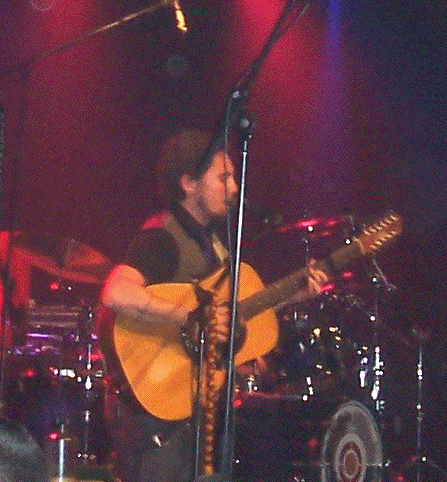
Commodore Ballroom, Apr 12, 2008 - Sold Out

Visit Swanktrendz

Live Nation Listings

An email from Christine instructed me to meet her in front of the Commodore at 10 p.m. to see the John Butler Trio. "Who's the John Butler Trio?" I wondered, turning to Google.

I soon found that they are a platinum-selling band from Australia, best known for wide-ranging, eclectic, and somewhat improvised stage shows. Their best known release, to date, is 2003's Sunrise Over Sea. I also saw many plaintive queries on various message boards asking "Where can I get a ticket for this show? I NEED a ticket!" and so forth.

Here's what we saw: a giant drum set, a standup (i.e. acoustic) bass, and an amplified acoustic guitar. They were joined occasionally by a keyboard player, and I was certain there was a second electric guitarist in the background, but was informed it was a guitar tuning tech.

The word "trio" is usually reserved for jazz ensembles, and there were some similarities here: the upright-bass player, who also played a standard electric bass guitar, at times played his acoustic bass with a bow; they played extended instrumental pieces; and the musical range was all over the map. There, though, the similarities ended.

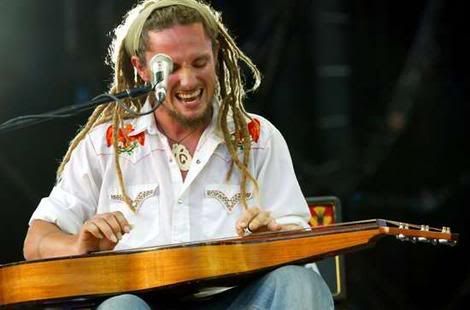
They are excellent musicians, far more instrumentalists than singers/"rock stars" who revel in mixing and matching genres and making it work. They are very versatile, imaginative, and well-rehearsed. John Butler is a superb string player (who also plays a banjo), and can coax an amazing range of sounds from an amplified 12-string acoustic guitar. The drummer was also very good, and even had a Jamaican steel drum that he played with pom-pons. And the bass player stood there and held it all together, as good bass players should.
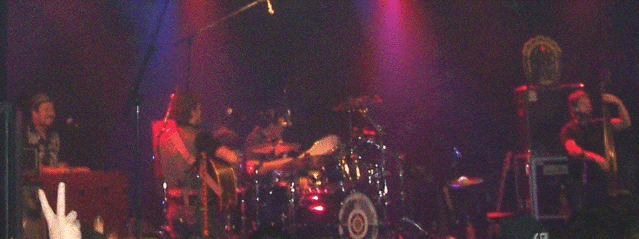
The audience was thoroughly familiar with the material, even if I wasn't, and they loved it. This band is definitely original, and I was left wishing I'd known more about them going in (there's always time to learn), and was puzzled by the crowds' reaction at times.

I've been to any number of jazz shows over the years, and seen some famous players (Miles Davis, Ornette Coleman, Frank Zappa, and even Captain Beefheart). I've also been to classic punk shows and seen The Clash, Iggy Pop, DOA, and so forth. At jazz shows, the audience applauds solos, but there's no mosh pit and no one EVER pogos. At the punk shows, no one cared about solos ("Wankers!"), or even cared much about music - there it was all rebellious attitude.

Here, the crowd's reaction was a strange merger of the two. They both applauded the solo instrumental and pogo'd. I've never seen anything quite like it. And, outside of jazz shows, I'd never seen any band sit down and play an instrumental piece (Ocean) that went on for 15 minutes, yet still keep the crowd's rapt attention.

Image from smh.com.au

I was very impressed by this band, and admire their virtuosity and originality. If you're as clueless as I am about under-the-radar musicians, the John Butler Trio might just be the best band you've never heard of.

Members of the band are: John Butler, Michael Barker, Shannon Birchall

Thanks to Aaron for supplying the following set list:
Company Sin
Used To Get High
Somethings Gotta Give
Treat Your Mama
Caroline
Thank You
Gov Did Nothing
Good As Gone
Ocean
Satisfy
Groovin' Slowly
Zebra
Good Excuse
(encore)
Losing You w/Mama Kin
Better Than
Funky Tonight

Saturday, October 18, 2008

AC/DC’s Latest Release Sold Only in Wal-Mart By Terry Lowe

Visit Swanktrendz

AC/DC had announced that its CD would be sold exclusively in Wal-Mart stores in the USA.

With this, their credibility dropped through the floor. AC/DC, in its early days, was a fun band; sort of a guilty pleasure – who couldn’t like the bouncy raunch of “Girls Got Rhythm?"

But Wal-Mart? Say it ain’t so, boys. Wal-Mart may be the world’s biggest retailer of CDs, but...

Wal-Mart is evil. Don’t get me started, or I’ll rant all night. Information on Wal-Mart’s cancerous “race to the bottom” tactics is not hard to find: just Google the term “Wal-Mart is evil” and you’ll find lots. And most of what you’ll find is both sad and nauseating.

The most interesting (and balanced) item I found was from the Markulla Center For Applied Ethics at Santa Clara University, who considered the question “Is It Ethical to Shop at Wal-Mart?” and concluded:
It is unethical to shop at Wal-Mart. However, refusing to shop at Wal-Mart is an insufficient response to its gross effects on the values of shared prosperity. You could do more, such as: Support local efforts to keep Wal-Mart out of communities. Support legislation that levels the playing field and prevents Wal-Mart from forcing down standards for wages and benefits.

AC/DC joins has-beens John Mellencamp, James Taylor, and The Eagles in the “Wal-Mart only” new release sales brigade. No further comment should be necessary, apart from noting that Bon Scott must be whirling in his grave.

Rumour has it that AC/DC had been in Vancouver this past August, putting the finishing touches on their CD. Did anyone manage to track them down and call them out on the Wal-mart monopoly? If so, please share your experience with me.

Ruby’s Chicky Boil-Ups (Radio Nowhere) By: Terry Lowe

Visit Swanktrendz


I love well-made radio almost as much as I love print media, so Internet podcasts are catnip to me. I found Ruby’s Chicky Boil-Ups by following a link from my favourite podcast, The Bike Show, broadcast from London by Jack Thurston on Resonance 101 FM (link below). The Bike Show, not surprisingly, focuses mainly on cycling. Ruby (who, it turns out, is Jack’s cousin) focuses entirely on music.

She chooses a loose theme for each show, then chooses a surprising range of music to fit each theme. She also finds a well-informed someone to talk to about this theme, and includes music that this person chooses. The result is eclectic, unusual, and wonderful.

How surprising? How eclectic? A few themes and playlists are shown below. Scroll down and have a look...

Sunday Service


Gospel Train - Sunbury Junior Singers of the Salvation Army
Heaven’s Radio - Molly o’Day and the Cumberland Mountain Folks
Female Jesus - Men in Gray Suits
Dominique - The Singing Nun
Saved - Lavern Baker
Jesus in His Pomp - The Chimps
Six and Seven Books of Moses - The Maytals as The Vikings
Joshua Fit the Battle of Jericho - Paul Robeson
Soul Train - Judith
Angels Laid Him Away - Mississippi John Hurt
Jesus Blood Never Failed Me Yet - Gavin Bryars

Tour De France


Rockin’ Bicycle - Fats Domino
En Bicicleta - Manuel Jiminez
La Troisième Roue De Ton Velo - Antoine
A Bicyclette - Yves Montane
Motorcycle - The Rumble Strips
Gravel Rash - Cookin’ on Three Burners
Pedal Pusher - Abdominal
Tour De France - Kraftwerk
Bravo Eddy - Jean Narcy
Blood on the Saddle - Tex Ritter
Henkie de Fiets - Henkie
The Highway Code - The Master Singers
Waiting At The Bus Stop - Kay-Gees
La bicyclette - Annie Duparc

The Great Outdoors


I Came Out of the Wilderness - Pete Molinari
Arizona Yodeller - DeZurik Sisters
Building a Boat - The Rumble Strips
Run Rabbit Run - Harry Smith
Country Death Song - The Violent Femmes
Moonlight & Roses - Tommy Sanderson Francis, Day & Hunter
The Valleys - Electrelane
Inakano Musume - Ban Ban Bazar
Goodbye California - Jolie Holland
Puszta-Fox - Orchester Barnabask von Geczy
Roam - B52s
La Montagne - Choeur des Armaillis de la Gruyère
Whispering Grass - The Ink Spots
Lord Blow the Moon out Please - Hem
Down by the Riverside - Lesley First
Man Walks Among Us - Jonathan Richman

Architecture


The Smoke Comes Out My Chimney Just the Same - Skeets McDonald
Do The Whirlwind - Architecture in Helsinki
This is the House that Jack Built - Willy Whyton
London Calling - The Clash
Luton Bungalow - John Hegley
First Row Balcony - The Gaylords
Love Breaks Down - Prefab Sprout
Home is where the Hatred Is - Gil Scott-Heron
I Wish to Build a Mosque - Markos Vamvakaris
In Your House - The Cure
Crying in the Chapel - Elvis
Living on the Ceiling - Blancmange
Maison Rose - Emmanuelle Parrenin
Underneath the Arches - Billy’s Banjo Band
My Head is My Only House Unless it Rains - Captain Beefheart
Lara’s Castle - Yann Tiersen
Come on Feel the Illinoise! - Sufjan Stevens
Build - The Housemartins
Christopher Robin at Buckingham Palace - Anne Stephens
We Built this City on Rock and Roll - Starship


Enjoy! I certainly do, and hats off(!) to Ruby.

Visit thebikeshow

Visit rubywright.wordpress

Monday, April 14, 2008

John Butler Trio - Concert Review by: Terry Lowe

Commodore Ballroom, Apr 12, 2008 - Sold Out

Visit Swanktrendz

Live Nation Listings

An email from Christine instructed me to meet her in front of the Commodore at 10 p.m. to see the John Butler Trio. "Who's the John Butler Trio?" I wondered, turning to Google.

I soon found that they are a platinum-selling band from Australia, best known for wide-ranging, eclectic, and somewhat improvised stage shows. Their best known release to date is 2003's Sunrise Over Sea. I also saw many plaintive queries on various message boards asking "Where can I get a ticket for this show? I NEED a ticket!" and so forth.

Here's what we saw: a giant drum set, a standup (i.e. acoustic) bass, and an amplified acoustic guitar. They were joined occasionally by a keyboard player, and I was certain there was a second electric guitarist in the background, but was informed it was a guitar tuning tech.

The word "trio" is usually reserved for jazz ensembles, and there were some similarities here: the upright-bass player, who also played a standard electric bass guitar, at times played his acoustic bass with a bow; they played extended instrumental pieces; and the musical range was all over the map. There, though, the similarities ended.

They are very good musicians, far more instrumentalists than singers/"rock stars" who revel in mixing and matching genres and making it work. They are very versatile, imaginative, and well-rehearsed. John Butler is a superb string player (who also plays a banjo), and can coax an amazing range of sounds from an amplified 12-string acoustic guitar. The drummer was also very good, and even had a Jamaican steel drum that he played with pom-pons. And the bass player stood there and held it all together, as good bass players should.

The audience was thoroughly familiar with the material, even if I wasn't, and they loved it. This band is definitely original, and I was left wishing I'd known more about them going in (there's always time to learn), and was puzzled by the crowds' reaction at times.

I've been to any number of jazz shows over the years, and seen some famous players (Miles Davis, Ornette Coleman, Frank Zappa, and even Captain Beefheart). I've also been to classic punk shows and seen The Clash, Iggy Pop, DOA, and so forth. At jazz shows, the audience applauds solos, but there's no mosh pit and no one EVER pogos. At the punk shows, no one cared about solos ("Wankers!"), or even cared much about music - there it was all rebellious attitude.

Here, the crowd's reaction was a strange merger of the two. They both applauded the solo instrumental and pogo'd. I've never seen anything quite like it. And, outside of jazz shows, I'd never seen any band sit down and play an instrumental piece (Ocean) that went on for 15 minutes, and keep the crowd's attention.

Image from smh.com.au

I was very impressed by this band, and admire their virtuosity and originality. If you're as clueless as I am about under-the-radar musicians, the John Butler Trio might just be the best band you've never heard of.

Members of the band are: John Butler, Michael Barker, Shannon Birchall

Thanks to Aaron for supplying the following set list:
Company Sin
Used To Get High
Somethings Gotta Give
Treat Your Mama
Caroline
Thank You
Gov Did Nothing
Good As Gone
Ocean
Satisfy
Groovin' Slowly
Zebra
Good Excuse
(encore)
Losing You w/Mama Kin
Better Than
Funky Tonight

Monday, March 03, 2008

Comedy Death Ray Review: By Terry Lowe

I fear that genuine wit is fast disappearing from the world, pushed aside by sarcasm, crudity, frantic neuroses, and if none of those work, sheer volume.

The Comedy Death Ray show at the Commodore featured plenty of sarcasm, a lot of crudity, the abovementioned frantic neuroses, all delivered at high volume. What it did not feature was much in the way of humour.

According to the Georgia Straight, Vancouver’s entertainment weekly (and not uncoincidentally, the producers of the show):

The lineup may not have the star power of the one that played the Global Comedy Fest last fall, but there’s still some solid talent: Doug Benson, Greg Behrendt, Dana Gould, Janeane Garofalo, Mary Lynn Rajskub, Tim and Eric, and the Fun Bunch.

The draw: This is the hip show in Los Angeles. Sure, it’s only five bucks there, but if you factor in airfare, you’re saving quite a bit.

Target audience: Risk-takers. Go for the celebrity names, stay for the unknowns.

Dana Gould’s marriage jokes were funny, Janeane Garofalo was mildly amusing, and Doug Benson was genuinely entertaining (and he was the only performer who actually connected with the audience). The rest of it sucked. This is not good value for money; I had a comp ticket, and by the end, it wasn’t even good value for no money.

Wikipedia lists many things that might be found in “alternative comedy,” and of those, Comedy Death Ray offers up two:

* Breaking social taboos: Particularly those relating to sex and bad language; alternative comedians swore on stage and, continuing the theme of observational humour, often made jokes about sex acts and sexuality. Toilet humour was not uncommon either.

* Story-telling and personal narrative: Emphasizing story, personal experience and individual rhythm instead of the rigid set-up/punchline jokes and rhythms of mainstream comedy.

Fair enough. Too bad they weren’t funny. Instead, they were abrasive, contemptous, and superficial.

I expect my reaction is a cultural one. One of the things Canadians do very well is comedy. We have very good comics working both here and in the US. I’d recommend seeking out some of these instead. If, however, you prefer your comedy without laughs, you may find Comedy Death Ray - um - “interesting.” I wouldn’t pay more than $5, and I’d look for somewhere with more comfortable seats (the better for some of the more squirm-inducing bits).

Rather than “comedy,” this show should have been billed as “Neurotic people yelling at you for two hours about their pubic hair issues.” If this is the best Los Angeles has to offer, then they need a lot more Canada down there.

Sunday, February 10, 2008

Sheldon Brown By: Terry Lowe

Visit Swanktrendz

Sheldon Brown was an American iconoclast; a builder, inventor, and innovator; a prolific writer, devoted family man, and possessor of an encyclopedic knowledge of all aspects of the bicycle. There was probably nothing he did not know, and write, about bikes, and there definitely was not anything he could not fix.

His many web sites, linked together at sheldonbrown.com, are an unmatched resource of cycling knowledge, most (but by no means all) technical or historical. As he put it:

As a kid, I used to gather discarded bicycle parts and put together bikes to sell for pocket money. I have been tinkering with bicycles ever since, sometimes as a business, always as a hobby.

“Tinkering” was characteristically modest. Of dozens of bikes Sheldon owned, my favourite is found here. It is an early-1970s O.T.B. (“Only The Best,” a private label assembled in Boston by a very discriminating dealer), which Sheldon modified to have 63 speeds, three gear shifts, and an extra front brake lever, which makes for lots of cables. Here’s how you get 63 speeds on a bike: start with a Sturmey-Archer 7-speed internally geared hub, add seven sprockets to the same axle, and run that with the standard three chain ring arrangement at the pedals. 7 X 3 X 3 = 63.

His wife is a computer scientist, and Sheldon may well have been one of the world’s first bloggers. He first put his site up in 1997, and added to it continually thereafter. It grew to be so extensive that anyone with a technical question checked there first. In cycling forums, newbie questions were usually directed there with the initials AASHTA (“As always, Sheldon has the answer”).

Sheldon was diagnosed with MS in 2006, which affected his balance, and that meant he was unable to ride his bikes anymore. He enjoyed riding a recumbent trike for a while, but soon was unable to ride even that, and so zipped around on an electric scooter. He still personally answered hundreds of emails every day, happily sharing his knowledge, helping people find obscure bike parts, and so forth. He was taken by a massive heart attack on Feb 3, 2008, at the age of 63.

The response has been phenomenal. Impromptu web site memorials have sprung up (locally, see sheldonbrown.blogspot.com), there have been memorial rides across North America, and the obits and eulogies are everywhere. I found this, for example, on bikeportland.org:

I had the pleasure of meeting Sheldon many years ago while conducting research for Giant Bicycles. His basement headquarters was an Aladdin’s cave of obscure and hard-to-get gear, and Sheldon was a gentleman and a great host. We played a game for a couple hours with me trying to come up with really obscure components and him locating the said part. Sach’s Duopar long cage rear mech? Third row, bottom shelf on the right. French-threaded Stronglight alloy headset? Sixth row, second shelf down on the left and so on, until I ran out of ideas. I particularly remember him proudly showing us his 1910 track bike with wooden tubular rims, “for riding on dry days only,” he said. He will be greatly missed.

Sheldon’s presence - even though I only ever knew him through his web sites - was so life-affirming and his joie de vivre so irrepressible that it’s hard to think of him in the past tense. My little world will never seem quite the same without him.

Goodbye, Sheldon (sniff), I hope you get to fix the bikes in Heaven.


Image by wikipedia, released into public domain by subject and owner of copyright (that’d be Sheldon himself, also an avid amateur photograper).

Monday, January 28, 2008

James Howard Kunstler’s Long Emergency By: Terry Lowe

Visit Swank’s Home Site

James Howard Kunstler is an American writer currently employed by Rolling Stone magazine. He is the author of The Geography of Nowhere (which we reviewed here), The Long Emergency, among others. He was in town recently as a visiting Fellow of Simon Fraser University, and gave a presentation the other night. I went along to see what he has been thinking about lately.

As far as Kunstler is concerned, the building of North American suburbia was a fifty-year-long experiment that has failed because shortages of oil in the near future will quickly render them unworkable. This failure will have profound effects on the way North American society is organized, and how it should approach its future.

He stated that the world’s oil supply peaked around 1999/2000, and has been declining since. He had facts and figures (duly shown), and the US Department of Energy agrees. The USA currently uses 20 million barrels of oil every day, and this oil (by 2020 or so) will no longer be available. We’d better start thinking about what to do about that, and soon.

That I knew already; please tell me more. Okay, here’s more:

The circumstances of the Long Emergency will require us to downscale and rescale virtually everything we do and how we do it, from the kind of communities we physically inhabit to the way we grow our food to the way we work and trade the products of our work. Anything organized on the large scale, whether it is government or a corporate business enterprise such as Wal-Mart, will wither as the cheap energy props that support bigness fall away. The turbulence of the Long Emergency will produce a lot of economic losers, and many of these will be members of an angry and aggrieved former middle class.

There is No More Oil, and the Earth is not making any more. It has more urgent things to do as it tries to cope with climate change.

Kunstler did not touch on climate change, referring instead to Al Gore’s well-known work on the topic. He did, though, list a few other predictions:

As oil becomes increasingly unavailable, 30-mile commutes also become undoable. Forget living in the ’burbs and driving off to work each day: it’ll soon cost you $100 in gas each way, and become impossible thereafter.

As sub-prime mortgages continue to collapse, a suburban home will decrease in value, until it becomes a liability. This is now happening all over the USA, in places that were believed to be recession-proof as little as two years ago.

Truckloads of produce from California will not appear in your grocery stores anymore, nor will truckloads of meat from Alberta or Montana. What will you eat? And where will it come from?

Likewise, similar loads (either by truck or by ship) of cheap stuff from China will no longer be delivered to the nation’s shopping malls. What is going to replace that? Will the exurban shopping mall survive?

He spoke about the important need to rebuild (in the USA, at least) a rail system that was pretty much abandoned in the 1950s when interstate highways were built. “The infrastructure’s still there,” he said, “out rusting in the rain.”

His most interesting idea was the simultaneous need to rebuild the also largely abandoned system of inland waterways. He comes from the Hudson River Valley in New York, and has seen entire towns closed down when the shipping business transferred to trucks on the Interstates, and the local factories and mills shut down in favour of cheap stuff from China.

His main idea is that we should go back to doing things the way they were done 60 years ago, before urban landscapes were defined by freeways and commuter traffic reports on the radio. Instead think of a landscape consisting more of farms and cottage industries, connected by rail and, where possible, canals. He thinks that cities would thus be more liveable (without endless suburbs), we’d eat better, and the economy would be healthier and more realistic. It’s a simplistic idea, but I think he finds it attractive (as do I).

Our lives will become profoundly and intensely local. Daily life will be far less about mobility and much more about staying where you are.

Is it possible?

I think it is, given political will and the benefits of selected bits of modern technology. Some Northern European countries are already setting examples. Then too, I’ve also heard people claim that if we could just capture a small percentage of the energy given to us for free every day by the sun, we’d have plenty of energy. Could that be done in 10 years? Probably not. Could it be done in 20 or 25 years? Probably.

Mr. Kunstler is a practiced and engaging speaker. Rather funny, too, referring to suburbs as “asteroid belts,” and saying things like “America today has a railroad system that the Bulgarians would be ashamed of.” What he says is well worth thinking about and, I think, only slightly exaggerated.


Saturday, January 12, 2008

Welcome to the Land of Light Contributed by Terry Lowe


On a cold late-December afternoon, I went for a bike ride along the Vancouver False Creek seawall. Stopped for a smoke, looked around, and found a surprising piece of public art in front of me. A sequence of metal words, bolted to the fence between me and the sea, in both English and what appeared to be a First Nations language. I started to read, and soon found myself reaching for my notebook and pen.

This section of seawall is a promenade with separated cycling and walking paths, built as frontage for a rampart of condo towers. This area was a toxic post-industrial wasteland 20 years ago, and most of the current condo-tower infill has been built within the last five years.

This city’s red hot real estate market has led to much consumer speculation in those years, with people lining up by the hundreds (if not thousands) to buy a slot in one of those towers, with no plan to actually live there, but rather sell it in a year or so at great profit. Around here there are worse strategies to make money, and many people have indeed realized great profits by riding this boom.

It does, however, lend a rather temporary feel to what’s been constructed. There are many boutique bistros and coffee outlets at ground level, but not much else. Tellingly, this particular area is becoming known as “Falsetown,” given its location on False Creek, and because there is no apparent sense of community there, apart from a transitory one built on cost per square foot and resale value.

No one I know wants to live there, but cyclists use it because it provides a car-free route from point A to point B, although it’s a route defined by convolution, and often clogged by dog walkers.

The city requires real estate developers to devote a tiny percentage of their overall budget to public art, and this is what I was seeing here:

       Greetings good you arrive here where light be under land

       Future it be now 

      Here you begin live like new

       Come to time where people talk different but good together

       If you heart mind open you receive new knowledge

       You have same like electric eye and heart mind and talk sound

       You live fast like light

       See talk be here there and everywhere at one time

       Us make this community good indeed

       You not afraid here

       Here you begin live like chief

       World same like in your hand

“You have same like electric eye?” What does this mean? Who made this? I went over to the condo developer’s office and asked. They called me the next day (people will tell you a lot if you just ask them to), and directed me to the City of Vancouver’s web site, Public Art section.

There I found that the artist’s name is Henry Tsang, that he was born in Hong Kong and raised in Vancouver, and that what I thought was a First Nations language was actually an almost extinct 19th century pidgin called Chinook Jargon.

The artist states:

Welcome to the Land of Light is a contemporary monument to the relationship between those who have lived on the False Creek waterfront and those who will arrive in the future to call this area their home. For the artist, this public art project is about the concept of home, the building of community, and with the aid of interactive fibre-based technology, the creation of a new world to experience.

“Interactive fibre-based technology?” Yes, indeed. There’s a thin ribbon of fibre-optic cable embedded in the concrete beneath the aluminum railing. If you view the piece at night, this ribbon glows and slowly changes colour.

... where light be under land ...

Here (where light be under land, where people talk different but good together) we’re still waiting for those who will arrive in the future to call this place their home. The installation of this piece that “addresses the concept of home and the building of community” on the artificial Falsetown seawall is an interesting gesture from a very clever artist.

Monday, August 27, 2007

Disappearing Burger Joint Blues By: Terry Lowe

Visit Swanktrendz’s home Site

Where burgers are concerned, I’m pure Jughead: “Give me one of those, and one of those, and one of those, too.” Would I like fries with that? Yes, of course I would! And I want a milkshake, too.

My newspaper told me a while ago that Vancouver’s landmark Fresgo Inn on Davie Street has closed. Closed! Not only has it closed, it has been replaced by a performance venue/restaurant/lounge featuring burlesque acts by drag queens, oh my. Thirty years of Fresgo’s erased just like that.

At least two generations of youngsters stumbled (or sometimes tumbled) into Fresgo's at 2 AM to devour mushroom burgers and vast mounds of fries. I was one of them way back when, and my memories of Fresgo’s are all enjoyable, if somewhat indistinct. If I can’t go there anymore, where shall I go, then?

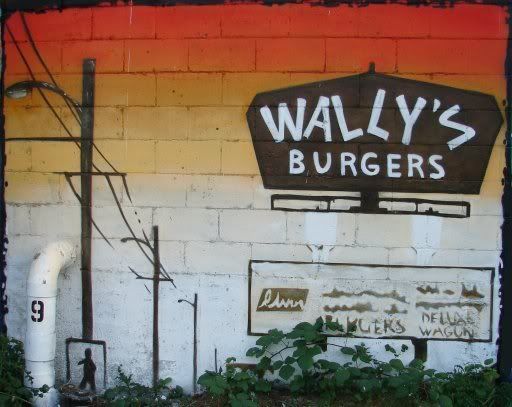
I set off for Wally’s Burgers, out on Kingsway in deepest East Van, eager for a Deluxe Wagon Burger, some fries, and a milkshake. Wally’s is a classic 1950s drive-in burger joint, perhaps the last such remaining here. I found that Wally’s, alas, is on its last legs: the vintage neon sign is being dismantled; there are no milkshakes available, and no pop machines, either. These last have been replaced by a generic Pepsi cooler.

The Deluxe Wagon burger remains, though: a wonderfully sloppy construction featuring two patties in a big bun (with condiments and secret sauce). But the amount of fries has been reduced by half, and there weren’t too many customers present. I was pleased, though, to see two guys show up in a heavily customized muscle car: a reminiscence of Wally’s hot rod past as the cool place to be.

Times change, I realize, and if we’re losing or about to lose the classic old burger joints, who is replacing them? And what’s the new approach to selling the time-honoured burger + fries + milkshake combo?

Some Googling to find Vancouver’s latest and greatest burger joints yielded a few contenders, so I applied bike tires to pavement to investigate each in turn.

Vera’s Burger Shack (various locations)

A truly tasty big burger, and a friendly method of ordering: they ask for your name, and then yell for you when your order is ready. But the location on Main Street (at 14th Ave) has appalling ambience. The only tables are picnic tables, otherwise you must sit on a stool at a narrow shelflike bar; there’s a giant-screen television dominating the room showing idiotic sports like wrestling or stock car racing; and the only beverages available are pop, juice, or bottled water. Go here only for takeout, like most other people do.

Burgers Etc (North Burnaby)

A cozy little cafe on Hastings near Gilmore, also with big yummy burgers. Table seating is available, with servers, and a standard burger with fries and a pop (no milkshakes, no coffee or tea, but they do have a liquor license) cost me $10.34. Not bad at all, I thought. A delicious burger (etc), but the music’s too loud. I’d go back if they turned the volume down and offered me some coffee. How hard is it make coffee? Or, for that matter, to make a milkshake?Hamburger Mary’s (1202 Davie Street, Vancouver)

Hamburger Mary’s has graced Vancouver's West End since 1979, serving up burgers that are 1/3 of a pound of chopped beef steak (other meats are available, along with chicken and salmon), well-garnished, and with a tasty barbecue sauce. Fries are included in the price printed on the menu, AND they have milkshakes, coffee and tea, and an outdoor patio. And a liquor license. And soup. And they’re right downtown. And they’re open til 3 AM. What's not to like here? My vote goes to Hamburger Mary’s, long may she prosper.

Sunday, March 25, 2007

Eric Clapton, Guitar Hero - Mar 27, 2007 @ GM Place

By: Terry Lowe

Eric Clapton is a living legend, and that is reason enough to go and see him, even if his work has been a bit lacklustre in recent years. Christine told me that the show was sold out (15,000 people, I was told later), but a ticket had been set aside for a SwankTrendz reviewer. I claimed that ticket and found my way inside with 10 minutes to spare.

I knew the show was to start at 8:30 PM, and was being presented by House Of Blues. The place was jammed with people, some of whom were young classic rock fans, but most middle-aged (with kids). I saw a brisk trade in $60 T-shirts at the concession stands. “Okay, it's going to one of those shows,” I thought: one that begins exactly on time – which I like – and ends exactly on time, and will probably be a tightly scripted crowd-pleaser.

I was right about that, but enjoyed it nevertheless. Good band, and a good seat, on the aisle 16 rows up from the front left corner of the stage. And very close to a big video projection screen, which came in handy for those close-up details.

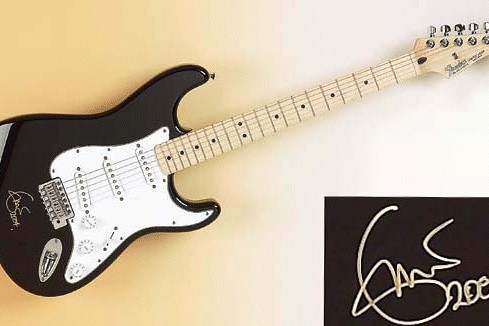
Mr Clapton and the band appeared on stage at 8:35, picked up their guitars and launched into a succession of 1970s Derek and the Dominoes hits: “Tell The Truth”, “Key To The Highway”, and “Got To Get Better In a Little While.” EC appeared relaxed and casual, wearing a dark grey short-sleeved shirt, jeans, suede deck shoes, and a few days’ worth of grey stubble. He played his signature black Stratocaster throughout.

claptonstratcrop

The band included a solid rhythm guitarist, a rocking bass / drum team, one organist and one electric pianist, and two lovely buxom backup singers who swayed in unison, and who were given chairs so they could rest during the “Shut up and play yer guitar” bits, of which there were many.

The sound quality was surprisingly good, given that the venue is a small stadium designed to host hockey games. I could hear everything clearly, and the mix was excellent.

When they launched into “Little Wing,” out came the cigarette lighters, held up aflame. Certainly not as many as there would have thirty years ago, but it certainly took me back. There was a lot of smoke in the air, and the noticeable smell of marijuana now and then.

That piece drew a semi-standing ovation; this crowd was clearly there to be pleased. “I Shot The Sheriff” drew another one, but what I noticed during EC’s extended improvised solo was that he still has it: his playing is astonishingly good, and very fluid. The camera operators gave us many close-up of the legendary Slowhand bending strings and dancing across the frets. He’s a magician with that guitar.

A refreshing sit-down acoustic set followed, with EC playing a solo six-string first, then joined by the remainder of the band, with the drummer playing a box that he was sitting on. This set included some songs unknown to me, although if the set list from last night's show in Seattle that I found on whereseric.com matches tonight’s (and so far, it has), those would be “Driftin” and “Outside Woman Blues” by blues legend Robert Johnson. Followed by “Nobody Loves You When You're Down and Out” and “Running On Faith,” during which the rhythm guitarist picked up his Strat, and the volume was turned up, and the stools cleared away.

A blazing version of “Motherless Children” followed, and to me, that was the highlight of the night. Inspired playing; and from there on it was just Greatest Hits to the end.

First, though, they had to play an extended blues-based piece, to showcase the solo abilities of the two keyboard players, the bass player, and, yes, the drummer. Playing blues-based rock, especially in stadiums, is risky. There's always the danger of slipping into formulaic or, worse, bombastic cliches. Clapton’s band was never bombastic, but there were formulaic here: all of your favourite “big rock stunts” delivered in one piece. My attention wandered. I noticed on the close-up video screen that EC's wristwatch was set an hour ahead. I admired the swaying backup singers.

The crowd ate it up, though, and wanted more. He could do no wrong, in their view. Proof of this came next: “Wonderful Tonight,” a song I've always found maudlin and tiresome. But out came the lighters again, almost as if on cue.

And then they played “Layla.”

And the crowd went nuts. They roared and stomped. I was curious to see if they’d play the extended version, with the duelling lead guitars. They did, but first had to wait for a standing ovation to settle down halfway through. And when they finally finished, the crowd gave them another ovation.

When the stage lights died thereafter, the crowd responded by making more noise than the band had all night. They wanted that encore, and of course, they got it. The time now was 10:10 PM, and I figured it was probably going to be “Cocaine,” and I was right again. They turned that into another Big Stadium Rock number (extended version), EC playing a white Strat this time. I figured that was probably it, so grabbed my coat and took off. Never could stand that song.

It’s a curious phenomenom, this adulation of 1970s music, often by people who weren't even born when it was originally released (and who thus cannot possibly appreciate its original context). Eric Clapton is known as a shy man, at times bewildered by and uncomfortable with the success his talent has brought him. Perhaps, then, he is content to deliver the seamless Greatest Hits package we saw there. The fans are certainly happy to get it.

Overall, I was glad to see him, and the band more often than not kept my interest. But that was due more to EC’s amazing playing than anything else; it would be wonderful to see him in a more relaxed setting, where he could bend our ears like he bends those strings.

Tuesday, February 06, 2007

Five or Six Songs That Affected my Life by: Terry Lowe

Swank Home

Swank’s tblog Home

Swanktrendz Myspace Home
Photobucket - Video and Image Hosting

The first real rock’n’roll song I ever heard was ‘No Time Left For You’ by the Guess Who, probably around 1965, on the car radio. I loved that electric guitar sound (provided by Randy Bachman), and wanted more. “No, leave it ON...” I pleaded when my Dad changed the station. He didn’t, so I got my own Westinghouse transistor radio from somewhere, and stashed it beneath my pillow at night, when I could pick up stations from exotic windswept places like Minneapolis or Chicago. I can remember far enough back when Elvis was still on the Hit Parade, hey now.

* Born To Be Wild - Steppenwolf. First record I ever bought, back in ye olde days of 12" vinyl LPs. I was just a kid, and this was the first rock’n’roll record ever in our house. It was not met with much parental approval.

* Stuck Inside of Mobile (With the Memphis Blues Again) - Bob Dylan. Still just a kid, and wondering, “What on earth is he talking about? And why do I LIKE this weird shit so much? Who IS this guy? What is going on here?” Those are all good questions for youngsters isolated in small towns to ask.

* School’s Out - Alice Cooper. An immortal anthem for the immortal snotty adolescent in all of us. Those opening guitar licks that sound like a fire alarm still send thrills and chills down my spine. Ah, fleeting youth. That feeling was briefly regained the first time I heard London Calling by the Clash, but that was years later and The Clash were not at all snotty. I think Alice was the first punk. I digress...

Photobucket - Video and Image Hosting

* Walk on the Wild Side - Lou Reed. So sultry with the double bass guitars and the saxophone at the end. I was still a naive adolescent living in a small town in the middle of nowhere, and the decadence in that song seemed SO attractive.

At the time, I’d never heard of Eric Burdon and the Animals. I didn’t know We Gotta Get Outta This Place (didn’t have a girl, either). Had I, that would have been our theme song. My loss at the time, but I was delighted to see that song resurface decades later, covered by DOA and Jello Biafra. I digress again, oh my.

* Peaches en Regalia - Frank Zappa (first track on the 1969 ‘Hot Rats’ album; I was a latecomer). Opened up a whole new world, that of instrumental music that could be both cool and interesting at the same time. I owe FZ a lot for that: it led directly to Duke Ellington and Oscar Peterson, Miles Davis and Charles Mingus, and an understanding of what sultry and cool really sounds like.

* Key To The Highway - Sonny Terry and Brownie McGhee, on some old Vanguard blues anthology. Opened up another whole new world: How can two old guys (one playing harmonica and the other playing a six-string acoustic guitar) sound so good? “Time to get outta here and find out,” I thought, and did.

Despite all those wild youthful rock’n’roll influences, I turned out to be not wild, nor decadent, but instead rather quiet and thoughtful. Being young is usually difficult; I certainly wouldn’t want to do it again. Music helps, and that which helps most is what you remember the longest and most fondly (yes, even Alice Cooper).